Mia Beck · 2 September 2026
Researchers from the Institute of Optical Sciences have published groundbreaking findings on light refraction in the Journal of Photonics Research. The study explores how light behaves when passing through engineered metamaterials, revealing deviations from traditional models.
Key Experimental Results
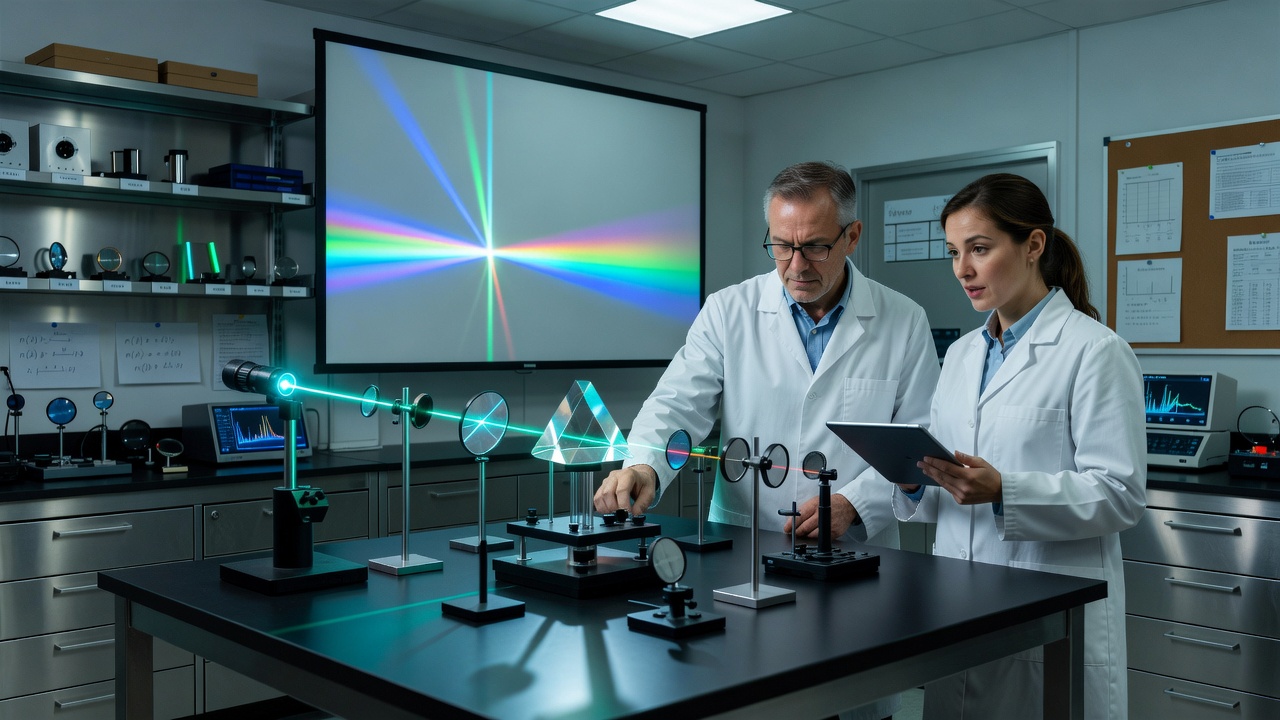
The experiments directed laser beams through layered nanostructures that manipulate refractive indices at the nanoscale. Results showed deviations from Snell's law predictions by up to 15 percent under specific wavelength conditions, attributed to quantum confinement effects. Data collected over six months using high-precision spectrometers confirmed consistency across trials. The team noted enhanced light bending that could improve optical devices. Mathematical models predict refraction patterns under temperature variations and electromagnetic fields, providing a foundation for future photonics research. Over 200 samples were tested with replication in independent labs yielding p-values below 0.001. Unexpected color dispersion patterns suggest applications in advanced spectroscopy.
Impact on Science Education
At Prism Hub Science Education these findings support curriculum updates on optics. Educators can use real-world examples of metamaterials in lessons to illustrate complex refraction concepts via interactive simulations based on the study data. The research underscores interdisciplinary methods combining physics materials science and mathematics. Students are encouraged to replicate aspects with accessible equipment to build critical thinking. The open-access article includes datasets for further analysis. Prism Hub will host webinars on implications for light manipulation technologies aligning with its goal of accessible cutting-edge education.