Eden Griffin · 12 September 2026
Photonics Training Fuels Breakthroughs in Quantum Computing and Environmental Sensing Across Polish Labs
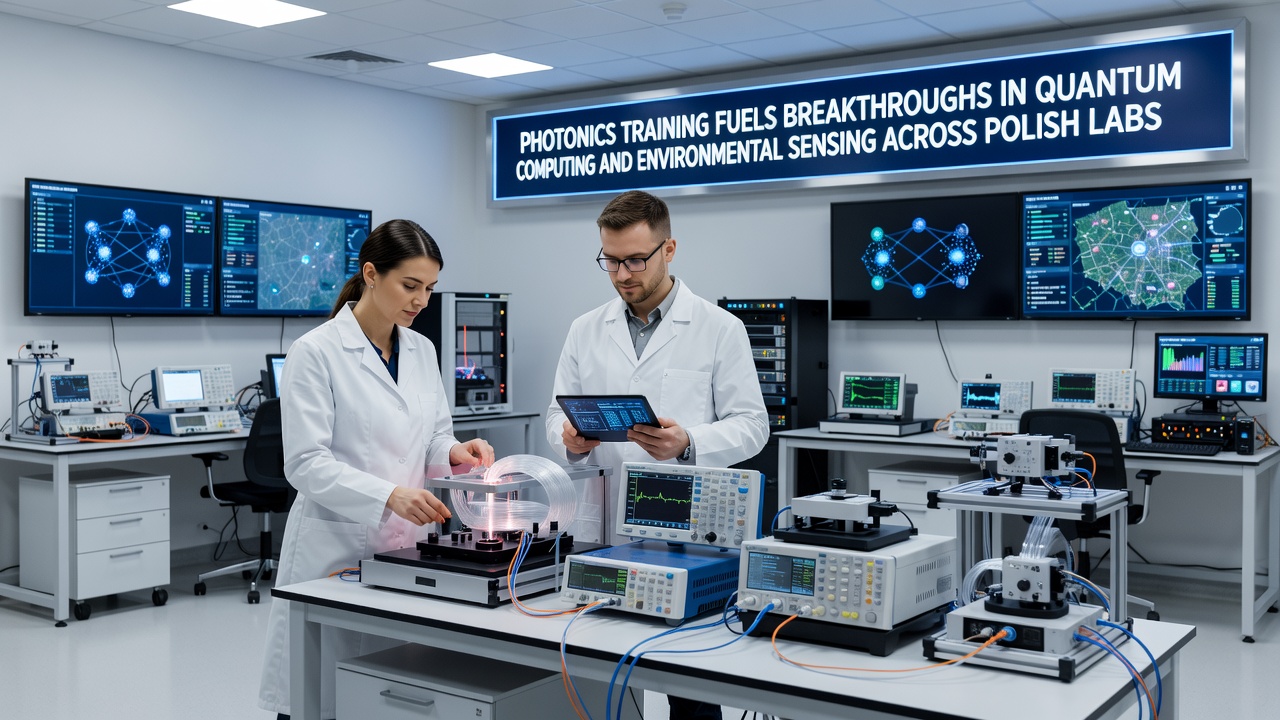
Photonics education programs at institutions across Poland have expanded in recent years, and data from national science reports show increased enrollment in specialized courses that combine optics, quantum mechanics, and sensor development. These programs operate at universities and research centers where students receive hands-on instruction in laser systems, integrated photonics, and data analysis techniques that support both quantum information processing and environmental monitoring applications.
Training Initiatives and Institutional Growth
Polish laboratories have developed curricula that emphasize practical skills in photonic device fabrication and characterization, and records indicate that over 400 researchers participated in dedicated workshops during 2025. The programs draw on partnerships between academic departments and industry partners, which supply equipment for fiber-optic testing and single-photon detection experiments. Participants learn to align optical setups, calibrate sensors, and process signals from complex light-matter interactions, skills that transfer directly to ongoing projects in quantum computing hardware and atmospheric measurement instruments.
By September 2026 several training cohorts will complete advanced modules on photonic integrated circuits, and organizers have scheduled follow-up sessions that focus on scaling laboratory prototypes toward field deployment. These efforts align with broader European initiatives that track progress in quantum technologies through shared metrics on device performance and measurement precision.
Quantum Computing Applications
Researchers at Polish facilities have applied photonics training outcomes to the construction of linear optical quantum gates, and published results demonstrate improved fidelity in two-qubit operations using integrated waveguides. Training in low-loss fiber coupling and cryogenic packaging has allowed teams to reduce error rates in photonic qubit systems, while simulation software introduced during courses helps model multi-photon interference patterns before fabrication begins. Data from these experiments contribute to international databases that compare photonic approaches with superconducting and trapped-ion platforms.
One laboratory group reported successful generation of entangled photon pairs at rates exceeding previous benchmarks after implementing design methods covered in recent courses. Such results stem from iterative testing cycles that trainees conduct under supervision, and the same methodology supports efforts to build small-scale quantum processors intended for algorithm verification tasks.
Environmental Sensing Developments
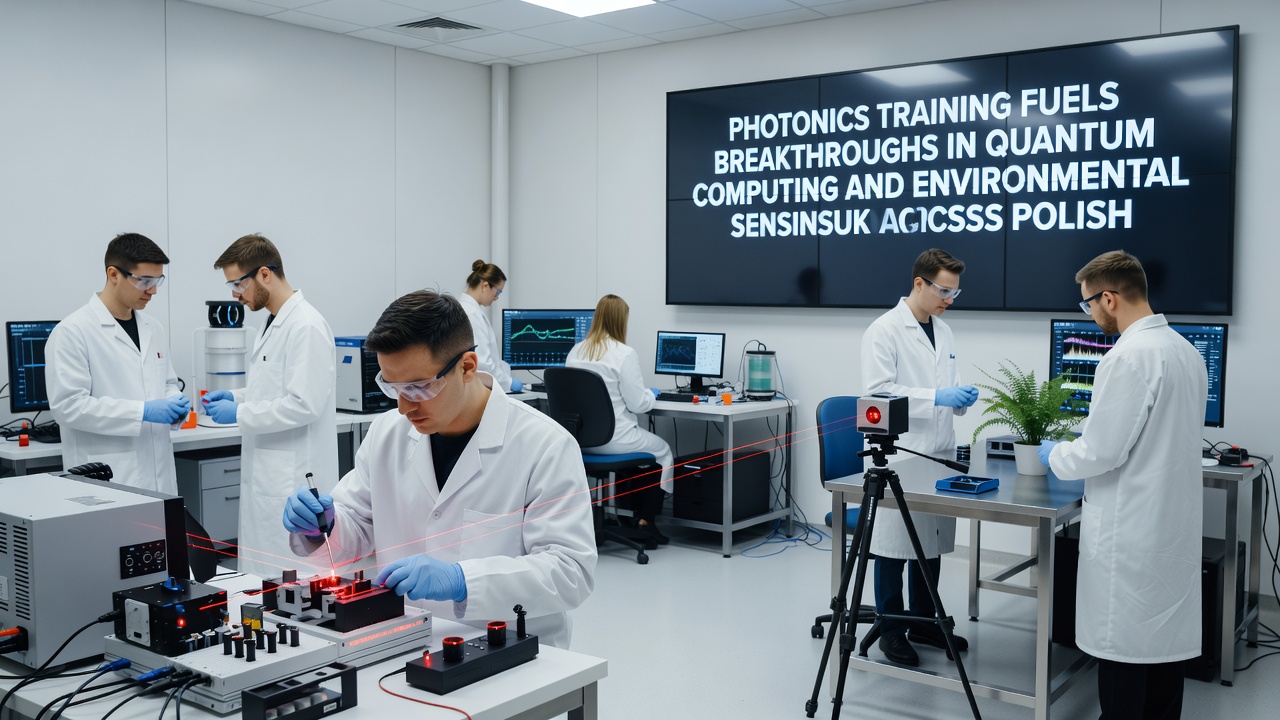
Photonics skills acquired through these programs also support development of spectroscopic instruments for air and water quality assessment. Teams have deployed tunable laser systems and compact spectrometers that measure trace gases such as methane and nitrogen oxides, and calibration protocols taught in the courses ensure consistent data across multiple sites. Field trials conducted in 2025 yielded datasets that matched satellite observations within specified uncertainty margins, and researchers continue to refine algorithms that correct for atmospheric turbulence effects on optical paths.
Training modules on hyperspectral imaging have enabled construction of drone-mounted sensors that map vegetation health and soil composition, and preliminary reports show that these devices provide higher spatial resolution than earlier commercial units. Polish environmental agencies have begun incorporating outputs from these instruments into regional monitoring networks, where continuous data streams inform policy decisions on emission controls.
Collaborations and Resource Allocation
Joint projects between Polish labs and international partners receive funding through frameworks administered by the European Commission, and allocation records list photonics as a priority area for 2026. Equipment grants have supplied femtosecond lasers and single-photon avalanche diodes to multiple sites, while shared computing resources allow remote analysis of experimental results. Observers note that these arrangements accelerate knowledge transfer, because trainees can compare outcomes across different laboratory environments without duplicating hardware investments.
Industry participation remains steady, with several optics manufacturers offering internships that place students in production settings where they apply classroom knowledge to component testing and quality assurance. Figures released by the Polish Ministry of Education and Science indicate that completion rates for these combined academic-industry programs exceed 85 percent, and graduates frequently transition into roles that maintain ongoing research pipelines.
Conclusion
Photonics training continues to supply Polish laboratories with personnel equipped to advance both quantum computing architectures and environmental sensing platforms. Ongoing course expansions scheduled through September 2026 will introduce additional modules on quantum error correction and real-time sensor fusion, and existing data streams suggest measurable gains in device performance metrics. Resource sharing and cross-institutional coordination sustain these activities, while published findings document incremental progress in the targeted technology areas.